
Contractstore - Legal Documents

ContractStore Catalogue

Search for:

New user? Register here | Returning user?  Log-in here  

Legal documents for business

A102 - Agency Agreement Template (favouring the Agent)

Description and usage

Agency Agreement Template (favouring the Agent)

Suitable for an agent who wishes to act as agent for a manufacturer or supplier on an exclusive basis in a defined territory.

A fairly detailed agreement with 10 main clauses covering the agent's appointment, duration, minimum sales targets, general obligations of agent and principal, procedures for ordering products, intellectual property, termination, non-competition etc. This version is written from the agent's point of view. For a bias in favour of a principal see document No. A101.

This document is designed as a template for international use.


What's in it? - Read explanatory notes


Ready to Buy?

Agency Agreement Template (favouring the Agent)

£48.00 + VAT

Your purchase will be available for online download from the 'My Contracts' area immediately after you have paid.


Add to favoritesClick here to add this page to your favorites/bookmark.

You will find this contract in:

Agents, Representatives and Distributor Agreements
International Contracts
Full Catalogue
All Commercial Contracts


You could also consider these related contracts:

Showing records 1 - 10 of 11.

A101Agency Agreement Contract (favouring the principal)
A114Representation Agreement Template
A115Representation Agreement (Tendering Contract)
A117Distributorship Agreement Template (favouring the Principal)
A132Commission Agreement
A151Supply Manufacture & Sale Agreement
A153Appointment of Sales Consultant
C101Chinese Agency Agreement Template
C132Chinese Commission Agreement
C138Chinese Long Term Supply Agreement

Page: 2 Next


What's in it?

Whilst for obvious reasons we can't show you the actual contract before you purchase it, we can do the next best thing, and, where available, show you the explanatory notes that go with it. These explain the thinking behind it, and give a good idea of its intended scope: 

Explanatory Notes

Agency Agreement Template (favouring the Agent)


EXPLANATORY NOTES

This Agency Agreement contemplates that a manufacturer or supplier of goods in one country will appoint an agent in another territory on an exclusive basis for the sale of those goods. The Agreement is fairly evenly balanced, but biased in favour of the Agent. Whereas a distributor buys for re-sale, purchasing from the Principal, the role of an agent is to sell on behalf of the Principal and usually on the Principal's terms and conditions of business.

Because of the cross-border nature of the Agreement, the Agent should have the text checked by a lawyer in the Principal's jurisdiction even if the Agent wishes to use the law of his own country, i.e. the Territory, as the governing law of the Agreement.

Specific comments on our model form, by reference to clauses, are set out below:

DATE AND PARTIES - see our separate note on Signing an Agreement (Miscellaneous Documents C144). In the case of the parties, the official address of each of the parties should be inserted and where a party operates under a P.O. Box Number, a physical address might also usefully be included.

INTRODUCTION - this is brief and needs no comment.

1. DEFINITIONS

This contains a number of defined terms that need to be considered by the parties in the light of their own particular arrangements. Where reference is made to a defined term, it is denoted by capital letters.

Products are to be listed in a Schedule. Especially when the relationship between the parties is a new one, the Principal will need to consider whether to list all his Products or only those which he considers are likely to sell most effectively in the Agent's Territory. It is sometimes possible for a Principal to appoint different agents for different products in the same territory. The Agent should be aware of this and endeavour to persuade the Principal that all Products of the Principal are covered by the Agreement.

If the Principal is new to the region where the Agent operates, the Agent may wish to propose that the Territory shall cover not only the Agent's own country but also neighbouring ones. In that case, wording may need to be introduced under which any local sub-agents that the Agent has to appoint are adequately covered under the commission arrangements with the Principal: suggested wording is set out in the last two sentences of clause 3.2 within square brackets. It is possible that the Principal may insist upon an indemnity from the Agent in the event of a claim being made by a sub-Agent against the Agent in respect of commission claimed by the sub-Agent. Any such suggested indemnity must be discussed with the Agent's local lawyers before agreement. Under English law the effect of an indemnity is to make it easier for a party claiming recovery of loss or damage rather than extending the scope of legal liability.

The Territory covered by the Agreement is defined by reference to a Schedule. The Territory may cover a complete country, part of a country or more than one country, but whichever the case, it is important to define it clearly. Do not, for example, refer to "any country in the Middle East", since there may be an argument as to whether certain countries are comprised in the Middle East.

2. APPOINTMENT AND DURATION

This confirms the appointment of the Agent on an exclusive basis - i.e. the Principal by appointing this Agent will not be able to appoint another Agent for the same products in the Territory.

In 2.2 the Agreement contemplates a fixed Initial Period of [2] years and after that the Agreement will roll over unless terminated.

3. MAJOR TERMS OF APPOINTMENT

The basic principle of this clause from the Agent's perspective is that he should be entitled to commission on all sales of the Products to customers in the Territory including Products sold elsewhere but destined for delivery to the Territory. This may be very different from the Principal's perspective under which, for example, certain sales are sensitive and the customer wants to deal only with the Principal. In such a case the parties need to reach agreement on what, if any, commission will be payable. As noted under "Definitions" above, where sub-Agents are appointed wording may be required to deal with payment of commission to the Agent on behalf of the sub-Agent.

4. AGENT'S GENERAL OBLIGATIONS

This contains a number of self-explanatory provisions requiring the Agent to promote the sale of the Products, undertake an advertising campaign etc. As this document is drafted from the Agent's point of view, it is shorter than the Principal might wish for. (See document A101 for a clause favouring the Principal).

5. ORDERS AND SALES

Since the Agent is selling on the Principal's behalf he is required in this clause to apply the Principal's list prices and not to offer any discount or impose any surcharge outside agreed limits.

The second alteration in 5.4 requires the Agent to pass orders directly to the Principal, which will be confirmed by the Principal. Payment will be made directly by the Customer to the Principal, but if the Agent does receive payment, he is required in 5.5 to forward the payment to the Principal within 30 days.

Commission is dealt with by reference to Schedule 3.

Clause 5.7 deals with statements to be sent to the Principal against which the Principal will make Commission payments. Under this wording, the Principal is required to pay relatively quickly from the date of receipt of a statement, which is acceptable to him. Longer payment periods would require adjustment of the wording. Interest is payable to the Agent in the event of late payment. However the Agent should note that although it is useful to include this provision in such an agreement it will often be commercially imprudent to insist upon payment of interest where there is a continuing commercial relationship. It should be noted that interest is not payable where it is agreed that an amount disputed was in fact not due to the Agent.

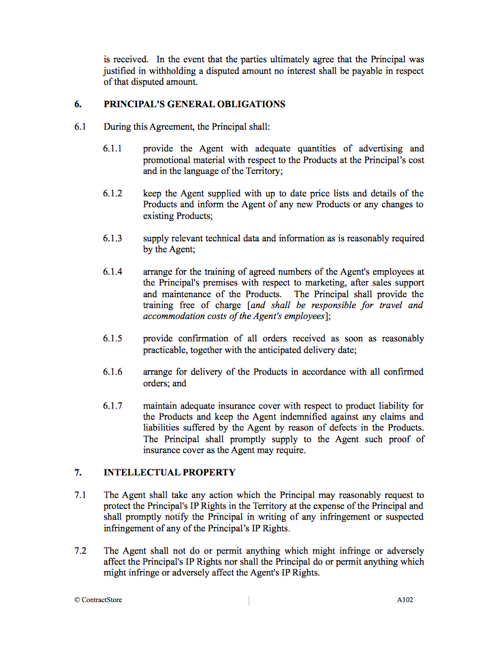
6. PRINCIPAL'S GENERAL OBLIGATIONS

For the Agency to operate successfully, the Principal needs to provide regular support, including advertising material, technical data etc. as well as ensuring the price lists are kept up to date.

In appropriate cases where training is necessary for the Agent's staff, 6.1.4 provides for the Principal to provide free training, and this may include the employees' travel and accommodation costs. Sometimes the Agent will bear such costs or they will be shared on an agreed basis.

The clause also obliges the Principal to confirm orders and make deliveries in accordance with those confirmations as well as maintaining product liability insurance and indemnifying the Agent against any Product defects.

7. INTELLECTUAL PROPERTY

The Principal will usually want to protect his trademark and registered name, which is not unreasonable. The Agent is required to notify any infringement and prevented from registering any of the Principal's trade names or other intellectual property rights. Provision for protection of the Agent's intellectual property rights is also included.

8. TERMINATION

Under our clause, either party can terminate in the event of the other's material (i.e. not trivial or insignificant) breach of contract or insolvency. Termination by the Principal may not be as easy in practice as this clause suggests and legal advice is needed before attempting to terminate.

8.3 deals with the consequences of termination and, as will be seen, outstanding sales will be honoured and the Agent will receive commission.

8.4 contains provision for the Principal to pay compensation to the Agent unless termination is due to the material breach of contract or insolvency of the Agent. This is intended to avoid disputes as to what the level of compensation should be but, once again, advice on this clause before the Agreement is signed is important. No compensation is payable in any event where the Agreement is terminated either before the end of the Initial Period or 12 months have elapsed from commencement of the Agreement.

9. NON-COMPETITION

This is intended to restrict the Principal from competing with the Agent's business after the Agreement has been terminated by appointing another agent in the Territory, unless the Agent's material breach of contract or insolvency was the reason for termination. (This is the opposite of Document A101)

10. GENERAL

This contains a number of standard provisions designed to regulate the arrangements between the parties.

10.1 restricts either party from assigning the agreement without the other's written consent. 10.2 gives the Agent the right to appoint sub-Agents. 10.3 deals with formal notices. In 10.6 we have suggested direct negotiation followed by mediation (if agreed) and, ultimately, arbitration in the event of disputes.

For other standard clauses and for a more detailed discussion of dispute resolution, see the Miscellaneous Documents on our website which can be downloaded free of charge. Also, you should get legal advice.

Finally, a reminder that you should get appropriate legal advice before using this Agreement.


Back to top


Important Notice
This notice applies to all materials and information available on this website.

All information and materials on this site are provided on an 'as is' basis and are not intended in any way to be comprehensive. Any reader making use of this site does so at his/her own risk and readers are advised to take independent professional advice before acting on any information or materials found here. The ContractStore Ltd accepts no responsibility and gives no representations or warranties, express or implied, that any of the information and materials on this site are complete, accurate or free from errors or omissions.

The contents of this site are protected by copyright. They may not be reproduced, distributed or published in any way without the consent of the ContractStore Ltd.