

What is this advance payment guarantee for?
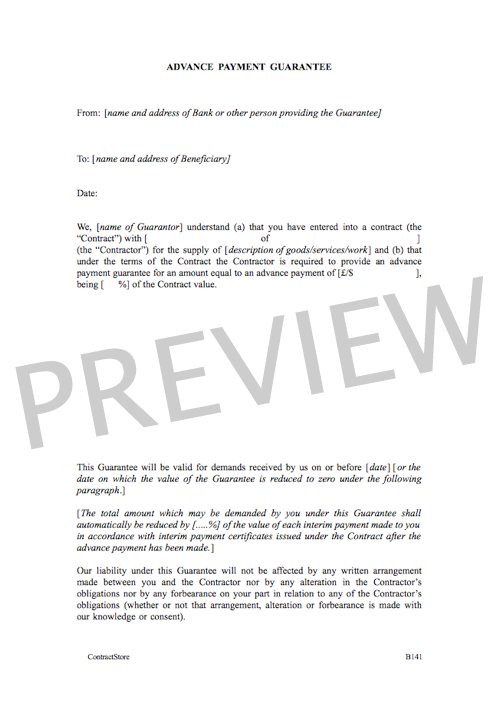
A developer will want this guarantee if it makes an advance payment to a contractor. So, it will require a guarantee from a bank or other financial institution as security against that payment.
A developer will usually require an Advance Payment Guarantee where, under the terms of a contract for the supply of equipment or services, the developer agrees to make an advance payment to meet the contractor’s mobilisation or other up-front costs. The amount of the advance payment is commonly somewhere between 10% and 20% of the Contract price.
What detailed terms does the advance payment guarantee contain?
Amount. The guarantee will specify the maximum amount of the guarantee, often being a percentage of the contract price which it relates to.
On demand. The guarantor will usually undertake to pay the amount guaranteed on demand – i.e. right away – when the beneficiary of the guarantee delivers a written demand , which will usually contain a pre-agreed statement – e.g. that the contractor’s employment under the contract has been terminated.
Reducing amount. Quite often the value of the guarantee reduces as the contract it relates to progresses and an agreed percentage of each payment application is deducted from the amount paid to the contractor, thereby reducing the guarantee by that amount. In effect each reduction amounts to a repayment of an equivalent amount of the advance.
Validity period. The guarantee will have an end date – a specified date after which the guarantee is no longer effective. Or when the value of the guarantee has been reduced to zero by the reductions mentioned above.
For more information on each of these sections, see our Explanatory Notes which you will receive when you download the document from our website.
And if you want to use the Notes, let us know by using our contact form
When I download the document, can I change it and/or use it more than once?
Yes, all ContractStore’s templates are in MS Word and you can use the contract on more than one project. For more information, watch the video on this page of our website or see our FAQs
Legal support
ContractStore supplies templates and is not a law firm. But all our templates are written by experienced lawyers so we can arrange legal assistance for customers who need special terms in one of our documents or a bespoke template. . For more information see our Legal Services page.
And if you want to contact us see our Contacts page.
If you have any questions about a contract and/or want to see these notes before you buy, please let us know by using our contact form
You may also find these contracts of use:

Tender Bond (Bid Bond) (B140)
£35.00Who can use this tender bond? A developer, buyer. public authority or other organisation. It is also known as a bid bond. What is this tender bond for? It is for use by a company

Short Form of Contract for Works & Services (B121)
£45.50Who can use this template contract for works and services ? Any individual or business that needs occasional building or similar work. What is this contract for? It contains a set of terms and conditions
Letter of Intent (Construction) (B124)
£31.50Who can use this Letter of Intent? Anyone who is negotiating a contract with a contractor and wants to get some work started before the contract is finalised. What is a Letter of Intent (LoI)